|
|
|
|
|
It's easy for the slender sailplane to stay aloft without an engine, since it is aerodynamically designed to glide efficiently through the air. Gravity slowly draws it toward the earth's surface. Generally, a 20-25 minute flight will result after the sailplane releases from a 3000 foot aero tow, when no rising air currents are found to extend the flight. The pilot in the sailplane can achieve a longer flight if the air mass in which he is flying is rising at a faster rate than the sailplane is gliding downward. When this happens, the real thrill of flying without an engine begins! The most common sources of lift are thermal lift, ridge or slope lift, and wave lift.
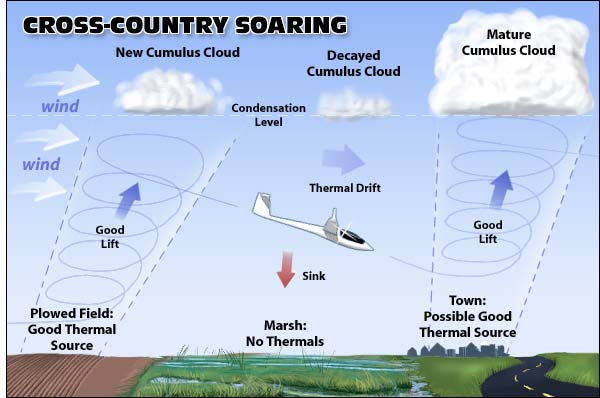
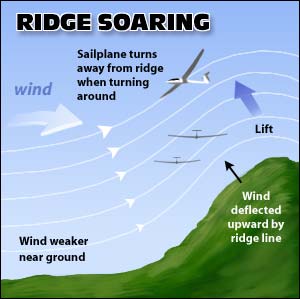
Thermal lift is dependent upon solar energy. The earth, when heated by the sun, warms the air next to it, causing it to expand and rise just like steam coming from a boiling kettle. Bubbles of warm, rising air form into columns called thermals. Some terrain absorbs heat from the sun more rapidly than the surrounding earth. Dark plowed fields, asphalt parking lots and rocky terrain absorb the sun's heat quickly and provide excellent sources of lift. Open countryside and desert lands are also known for their strong thermals. In some areas of the United States , sailplanes have ridden thermals up to altitudes of 25,000 feet! Ridge lift, also called slope lift, is dependent upon wind. When the wind blows against a mountain, hill, cliff, or ridge line, the air flow is deflected upward and depending on the strength of the wind can rise hundreds of feet above the top of the ridge. Sailplanes can fly back and forth for hours on the narrow band of rising air on the upwind side of the ridge. Flights of more than 1,000 miles have been made using the ridge lift along mountain chains.
|
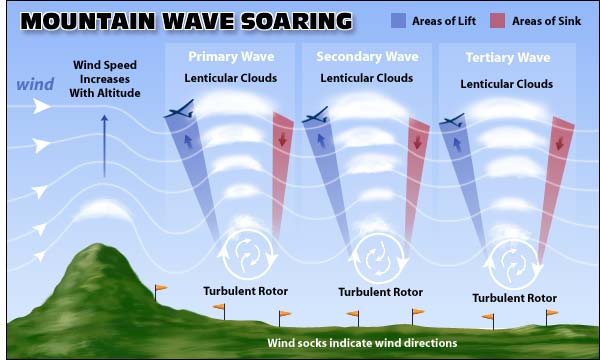
 Mountain wave flying is especially exciting to many glider pilots. This meteorological phenomenon occurs when strong winds (more than 25 mph) blow perpendicular to a mountain or ridge. The wind flows over the top of the obstruction and down the opposite side, where it bounces off a layer of stable air near the ground and is deflected upward many thousands of feet to stable air where it bounces downward again. This wave action can occur many times in succession and is very similar to what you see when water flows over a submerged log in a stream. Sailplanes can rise at 2,000 feet per minute or more in the rising air on the upwind side of each wave. Wave flights can reach altitudes of 35,000 feet or more. At these altitudes, supplemental breathing oxygen and other precautions are necessary.